What is synovial fluid?
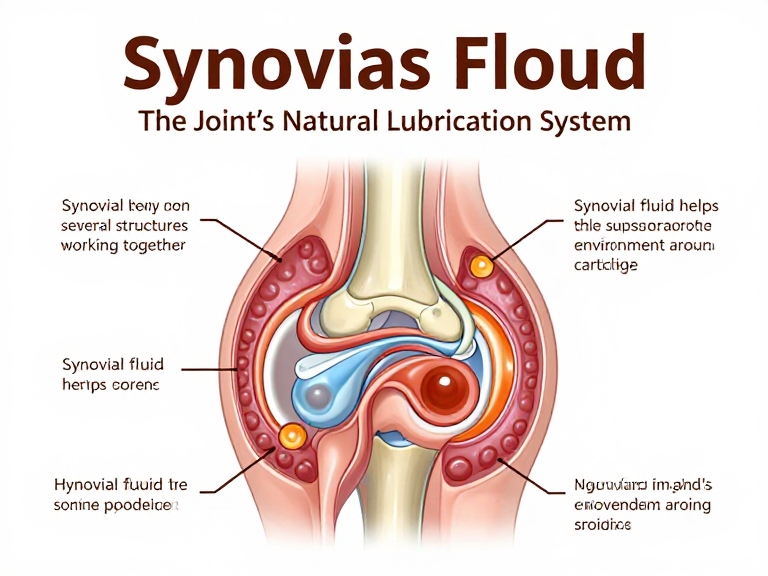
Synovial fluid is the fluid found inside many freely movable joints, including the knees, hips, shoulders and fingers. These joints allow the body to bend, turn, reach, walk and perform countless everyday movements. For movement to work smoothly, the tissues inside and around each joint must cooperate.
The inner surface of the joint capsule is lined by the synovial membrane. This tissue helps produce and regulate synovial fluid. The fluid occupies the joint space between the opposing surfaces of articular cartilage. It helps reduce friction as the surfaces move against each other and supports the local environment in which cartilage functions.
Synovial fluid is not simply water sitting between two bones. It is a biological fluid containing water, lubricating molecules, proteins and other substances. Its composition and behaviour help the joint respond to movement and mechanical demands.
How synovial fluid helps a joint move
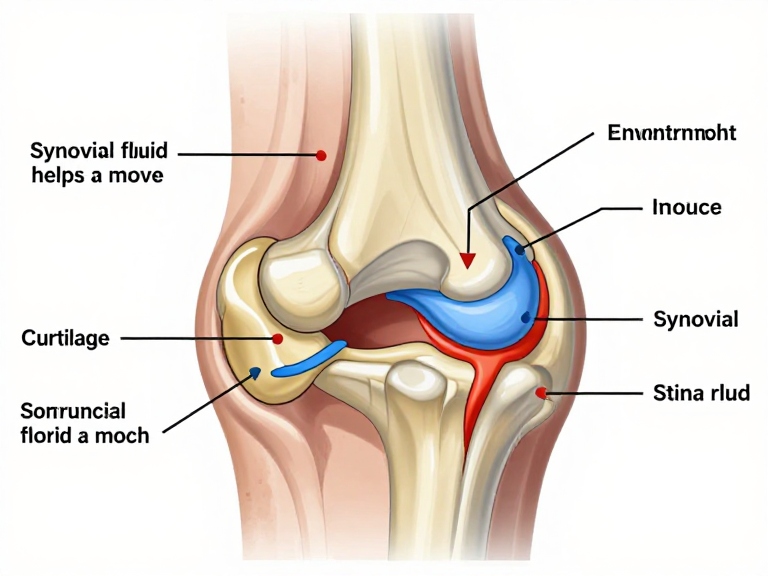
A healthy movable joint is a coordinated system. Cartilage provides a smooth covering over the ends of bones, while synovial fluid helps the opposing surfaces glide with less friction. The fluid also contributes to the environment around cartilage, which has no direct blood supply of its own.
During movement, pressure and motion change within the joint. Synovial fluid helps lubricate the surfaces under these changing conditions. The exact mechanics vary with the joint, the type of movement and the forces placed on it. Fluid and cartilage therefore work together rather than acting as separate, independent parts.
Where does hyaluronan fit in?
Hyaluronan, also called hyaluronic acid, is a naturally occurring molecule found in several body tissues and fluids, including synovial fluid. It is a long molecule that interacts with water and contributes to the fluid’s viscosity—its resistance to flowing. These properties are part of how synovial fluid behaves during joint movement.
The fluid’s lubrication performance depends on its overall composition and the conditions inside the joint. Hyaluronan is one contributor, not a complete explanation of how a joint feels or functions. Cartilage, the synovial membrane, ligaments, tendons, muscles and bone also matter.
One molecule, part of a larger system
Hyaluronan contributes to the viscosity and lubrication properties of synovial fluid. The fluid’s composition and performance can change with age and certain joint conditions. These changes are only one part of joint health. No single molecule determines whether a joint will remain comfortable or develop a condition such as osteoarthritis.
Understand the whole joint
A joint is more than the space between two bones. Several tissues have different jobs, and their combined performance allows the joint to move, bear loads and remain stable.
Cartilage: a smooth, protective surface
Articular cartilage covers the ends of bones where they meet in many movable joints. Its smooth, resilient surface helps reduce friction and distribute forces during activity. Cartilage works closely with synovial fluid, but it has limited capacity to repair itself when significantly damaged.
Synovial membrane: the inner lining
The synovial membrane lines the inside of the joint capsule, except across the articular cartilage. It helps produce and maintain synovial fluid. Changes or inflammation in this lining can affect the joint environment and may be involved in joint conditions.
Ligaments, tendons and muscles: support and movement
Ligaments connect bones and help guide or limit joint movement. Tendons connect muscles to bones, transmitting the force that creates movement. Muscles also support joints by helping control position and absorb some of the forces generated during everyday tasks. Their strength and coordination are important parts of joint function.
Bone: more than a framework
Bone provides the structure around a joint and responds to the loads placed on it. The bone immediately beneath cartilage is also involved in the joint’s mechanical environment. In conditions such as osteoarthritis, changes can affect several joint tissues, including cartilage, bone, ligaments and the synovial lining.
How can synovial fluid and joints change?
Age, previous injury, repeated high loads and certain health conditions can influence joint tissues. Synovial fluid composition may also change in some circumstances. However, there is no single pattern that explains everyone’s experience, and changes in fluid alone cannot tell the full story of a person’s joint health.
Osteoarthritis is a condition involving changes in the whole joint, not just a simple wearing away of cartilage. Symptoms and progression differ from person to person. Pain or stiffness cannot be reliably explained by one molecule or one image of a joint; a healthcare professional can assess symptoms in their wider context.
Everyday ways to support joint function
No routine can guarantee that a joint will never develop a condition. However, general movement and self-care habits can help support mobility and function for many people.
Keep moving regularly
Walking, swimming, cycling and other suitable low-impact activities can help maintain movement and general fitness.
Build supporting strength
Appropriate strengthening and mobility exercises can help muscles support and control joints.
Progress gradually
Increase activity at a manageable pace and allow recovery when adapting to new movements or workloads.
Get advice when needed
A clinician or physiotherapist can help adapt activity to your symptoms, needs and abilities.
If joint discomfort persists, repeatedly returns, limits normal activity or is accompanied by swelling, arrange a medical assessment. A joint that becomes suddenly very painful, hot or markedly swollen—especially with fever—or symptoms following a significant injury may require urgent medical attention.
The key takeaway
Synovial fluid helps lubricate movable joints and supports the environment around cartilage. Hyaluronan contributes to its viscosity and lubrication properties, but it is only one part of a much larger system. Cartilage, the synovial membrane, bone, ligaments, tendons and muscles all contribute to movement and function.
Understanding the whole joint gives a more balanced picture than focusing on one molecule alone. Joint symptoms and treatment options vary from person to person, so persistent concerns are best discussed with a qualified healthcare professional.